Kenya stands at a defining moment in its energy transition. With a national electrification rate reaching an impressive 79%, the country has made immense strides in connecting homes and communities to power. Yet, a critical gap remains less than one-fifth of the electricity consumed in Kenya is utilised for productive economic activities. There is a bigger gap in clean energy production.
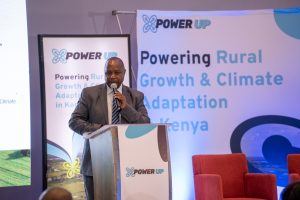
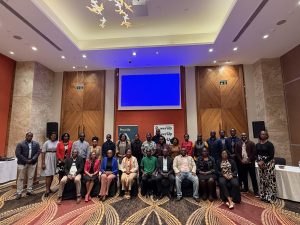
To address this challenge, leaders from government ministries, commercial banks, development partners, clean-tech innovators, and civil society convened in Nairobi for the Productive Use of Renewable Energy (PURE) Investment Roundtable, hosted by Power Up Kenya in partnership with the Ministry of Energy and Petroleum.
The message echoing through the room was clear: basic connectivity is no longer the final destination. The imperative now is to shift from lighting up households to powering economic engines transforming energy access into sustained industrial, agricultural, and enterprise growth.
The Economic Imperative: A $280M Market Opportunity – Opening the conversation, David Njugi, Chairman of Power Up and Board Member of the Kenya Renewable Energy Association (KEREA), set a decisive tone. He urged financial institutions from Tier-1 banks and SACCOs to microfinance institutions and impact investors to move beyond traditional risk-averse lending. Scaling adoption requires moving past fragmented pilot projects and actively unlocking patient capital, designing tailored end-user asset financing, and backing local energy innovations.
The business case for doing so is compelling. By 2030, Kenya’s PURE landscape represents a USD 280 million Serviceable Obtainable Market (SOM), capable of generating 2,914 GWh of productive energy demand and directly impacting over 13 million citizens across key sectors:
- Transport & E-Mobility (USD 99M SOM): Driving 40% of project value through electric two-wheelers, buses, and light commercial fleets.
- Education & Digital Learning (USD 50M SOM): Powering ICT labs, skill centers, and digital learning infrastructure.
- MSMEs & Light Industry (USD 48M SOM): Unlocking local value addition in milling, welding, carpentry, and commercial refrigeration.
- Agriculture & Cold Chain (USD 40M SOM): Boosting rural farm yields, reducing post-harvest losses, and strengthening food security through solar irrigation and localized cold storage.
Local Innovation in Action: Pioneering Circular Storage
Unlocking this market requires reliable, affordable energy infrastructure that meets end-users where they are. Highlighting what local ingenuity looks like, AceleAfrica Limited showcased its circular battery technology model.
Operating out of Nairobi with field operations spanning Kenya, Uganda, and Rwanda, AceleAfrica builds and repurposes lithium energy storage solutions to tackle energy unreliability. Across Africa, 660 million people lack reliable power, leaving small businesses to rely on expensive diesel backup costing between $0.30–$0.59 per kWh alongside frequent grid outages.
AceleAfrica addresses this by giving spent EV battery packs a second life. Retaining 85% state of health, these repurposed batteries are deployed as clean energy storage for solar home systems, micro-enterprises, clean cooking units, and localized agricultural processing. To date, the company has repurposed over 600,000 cells and deployed 3,000+ battery packs (~4.5 MWh). Through mobile units like its BATLab who are supporting Refugee Settlements, AceleAfrica proves that circular technology can deliver clean, localized power to even the most vulnerable communities.
Applying an Intentional Gender Lens to Green Investments
Technology alone, however, cannot scale without financial products designed for ground-level realities. As Alice Kyallo from Co-operative Bank noted during the discussions, successful financial intervention requires putting the grassroots end-user at the center of solution design.
This is where applying an intentional gender lens becomes critical. In rural economies, women perform the bulk of agricultural and domestic labor, managing diversified income streams under tight capital constraints. When local lenders structure tailored asset financing for productive appliances whether solar-powered cold storage, milling, or clean cooking tech they are doing more than funding hardware. They are directly liberating women’s time, increasing farm-level productivity, and bolstering household economic resilience. A gender lens is therefore not only a social consideration; it can help financial institutions identify underserved markets and design products around the actual cash flows and productive activities of women-led enterprises.
The Blueprint for Action: Moving from Concept to Scale
Driving a sustained clean energy transition requires every stakeholder to act—from government regulators operationalizing green taxonomies to local financial institutions developing dedicated green portfolios and enterprises advancing innovative clean energy solutions.
To unlock the USD 280 million market opportunity, participants identified priority actions and commitments that stakeholders can take to increase investment and accelerate the growth of the PURE sector:
- De-Risking & Blended Finance: Development partners, NGOs, and government bodies must provide credit guarantees, concessional funding, and first-loss capital to give local financial institutions and SACCOs the confidence to lend into the PURE sector.
- Demand Aggregation & Data Visibility: Stakeholders must generate verifiable subsector and end-user demand data to clearly demonstrate return on investment (ROI) and enable accurate risk profiling by commercial lenders.
- Ground-Up Co-Creation: Lenders and civil society must co-create financial products alongside grassroots communities, tailoring micro-products to smallholders and rural women.
- Policy Alignment & Coordination: Regulators and ministries (Ministry of Energy & Petroleum, Agriculture, Finance, and Industry) must harmonize cross-sector policies to eliminate institutional silos and streamline private sector investment.
- Capacity Building & Technical Assistance: Industry bodies (such as KBA and AMFI) and banking foundations should build internal capacity for loan officers while delivering financial literacy training to rural micro-entrepreneurs.
- Sustained Regional Collaboration: Stakeholders must commit to regular, resourced PURE Inter-Governmental Coordination (IGC) forums across regional hubs—such as Mombasa, Nakuru, and Kisumu—to advocate for fiscal incentives like tax relief and integrate regional program design.
The Road Ahead
The future of energy in Kenya relies on moving beyond simple access toward commercial bankability and productive utilization. By combining local technological innovation, gender-responsive financial products, and aligned cross-sector policy, Kenya can build a clean energy ecosystem that drives real, lasting socio-economic transformation. The opportunity now is to move from isolated transactions and pilots to a financing ecosystem capable of taking proven PURE solutions to scale.