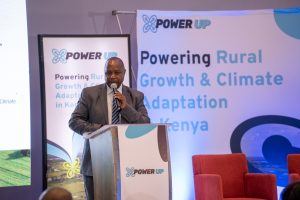
“Energy an enabler of development shaping how health facilities deliver services, how businesses produce, how communities access water, how institutions cook, and how counties respond to emerging economic and environmental priorities.
But unlocking this potential requires proper County Energy Plans plans that turn energy needs into clear priorities, guide investment, and connect energy to wider county development goals.” ~ H.E LUCY MULILI Deputy Governor Makueni County
For Power Up Kenya, the County Energy Plan (CEP) Learning Exchange in Makueni County provided an opportunity to explore what happens when energy planning moves beyond a policy document and becomes a practical tool for development.
The exchange brought together chief officers and Directors from 14 counties yet to develop county energy plans and 3 from counties that have developed and implemented their energy plans, creating space to share experiences around energy planning, data, stakeholder engagement, financing, institutional capacity and implementation. More importantly, it offered an opportunity to ask: what makes a County Energy Plan work, and what happens after the plan is approved?
Clean cooking belongs in the wider energy conversation
The discussions in Makueni come at an important moment for Kenya’s energy transition.
In his recent address to the United Nations General Assembly, Kenya’s President William Ruto argued that clean cooking should be treated as an energy infrastructure issue, rather than only a household concern. He highlighted the need to connect clean cooking with electrification, investment, public institutions and economic development.
This framing reinforces an important lesson from the Makueni exchange: energy planning cannot happen in isolation.
Energy is an enabler; it cuts across health, education, agriculture, water, enterprise development and environmental management. Clean cooking and productive uses of renewable energy are part of this wider picture, alongside electricity access and other energy priorities.
For counties, the question is therefore not simply whether to plan for energy, but how to make energy planning relevant to the county’s wider development agenda.
There is no one-size-fits-all energy pathway
Makueni’s experience demonstrated why county-specific planning matters.
The county has developed its County Energy Plan, an Investment Prospectus and an energy policy, supported by county leadership, consultation and partnerships. Its experience also shows how local resources and needs can shape energy choices.
For Makueni, abundant sunlight has created opportunities for solar-powered solutions across several projects visited during the exchange. Other counties may have different resources, infrastructure, economic priorities and energy needs and therefore different pathways.
County Energy Plans therefore cannot simply be copied from one county to another. They need to reflect local realities while creating a clear framework for implementation and investment.
A County Energy Plan is a process, not just a document
One of the strongest lessons from Makueni was that the value of a CEP lies in the process behind it.
Effective planning, as shown by World Resource Institute, requires reliable data, clear objectives, early stakeholder engagement and strong institutional ownership. County departments, communities, private-sector actors, development partners, civil society, technical institutions and national government agencies all have a role to play.
The planning process also needs to establish clear responsibilities, resources and mechanisms for monitoring and updating the plan.
Data is central to this process. Counties need to understand their current energy situation, establish baselines, and identify future demand. But data collection should begin with a clear understanding of what the county wants the plan to achieve and how the information will inform decisions.
Just as importantly, energy planning cannot remain the responsibility of the energy department alone.
Health facilities need reliable energy. Schools need energy. Agriculture depends on productive energy use. Water systems require energy for pumping. Businesses need affordable and reliable energy to operate.
Building ownership across departments and ensuring energy priorities are reflected in county budgets and programmes can help move the CEP from a technical exercise into a development tool.
Seeing energy planning in practice
The field visits in Makueni provided a practical view of how energy planning can translate into development outcomes.
At the County Assembly, participants explored the role of governance and leadership in advancing energy priorities. At Makueni Dairy, they saw how energy solutions can support productive economic activity. Visits to solar-powered water supply projects demonstrated how renewable energy can reduce dependence on conventional power sources while supporting essential services.
At Wote Technical Training Institute, participants saw the integration of institutional LPG clean cooking solutions alongside solar PV—demonstrating how public institutions can adopt cleaner energy solutions while managing operational costs.
Although the visit did not include a physical walkthrough of Makueni County Referral Hospital, participants also considered the hospital’s 205 kW solar PV system, supported by a KES 30 million investment, which powers daytime operations and generates significant electricity savings for reinvestment in patient care.
Together, these examples demonstrate how a County Energy Plan can provide a framework for connecting energy priorities with public services, productive uses, clean cooking and investment.
What can other counties learn?
The exchange also brought together experiences from other counties, highlighting both common challenges and different approaches.
In Kilifi, discussions focused on aligning the energy plan with the County Annual Development Plan and broader priorities, including the blue economy.
In Kakamega, participants reflected on the importance of mobilising resources around identified energy priorities.
In Nakuru, discussions highlighted proactive budgeting and exploring different financing opportunities.
Across these experiences, one message was consistent: a CEP has greater value when it is connected to the county’s actual development machinery planning, budgeting, investment, service delivery and monitoring.
The Makueni Learning Exchange reinforced an important principle: county energy planning works best when it is treated as a continuous, participatory development process.
For counties, this means:
- Building strong institutional ownership beyond the energy department.
- Strengthening capacity to implement, monitor and update energy plans.
- Improving energy data and using it to anticipate future demand.
- Integrating energy priorities into county planning and budgets.
- Using CEPs to connect local priorities with partners, investors and financing.
- Ensuring priorities such as renewable energy, clean cooking and productive uses of energy translate into implementation.
- Creating opportunities for communities and other stakeholders to participate throughout the planning process.
- Learning from other counties while adapting approaches to local contexts.
As counties consider how to expand access to clean, affordable and reliable energy, local planning will be critical to determining what solutions make sense, where investment is needed and how different actors can work together.